


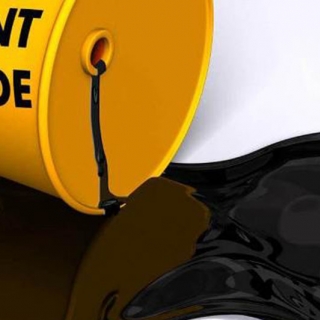
Oil edged down as uncertainty about US President Donald Trump's tariff plans muddies the economic outlook.
West Texas Intermediate futures fell 0.4% to settle above $71 a barrel, after gaining 3.1% on Monday. The S&P 500 also edged lower as Trump prepared to implement reciprocal tariff plans that have raised worries about the strength of the world's largest economy.
Trump has also threatened so-called "secondary tariffs" on buyers of Russian oil, potentially hurting flows from one of the world's top three producers, before later softening his tone. Elsewhere, Iran's Supreme Leader Ayatollah Ali Khamenei said any attack by the US or Israel would be met with "a firm retaliatory strike."
Trump's threat of penalties on Russia has added to a more positive short-term outlook for prices, with key timespreads pointing to a tighter market and derivatives tied to the vital North Sea benchmark surging. At the same time, WTI briefly entered overbought territory on its nine-day relative strength index for the first time since Trump took office, signaling that the past three weeks' rally may be set to pause.
Crude ended the first quarter little changed, despite significant swings in prices, as traders were buffeted by geopolitical risks, forecasts for a glut and increased supply from OPEC+ starting this month. While tighter sanctions on Iran and Russia could crimp supply, tariffs from the US may hurt global growth and energy demand.
WTI for May delivery slid 0.4% to settle at $71.20 a barrel in New York.
Brent for June settlement dipped 0.4% to settle at $74.49 a barrel.
Source: Bloomberg
Oil prices stabilized on Thursday (February 12th), as the market reassigned a risk premium to US-Iran tensions despite US inventory data showing swelling domestic supplies. This movement confirms one ...
Oil prices rose on Wednesday (February 11th), supported by a combination of geopolitical risk premiums from US-Iran tensions and more solid Asian demand signals particularly from India which helped ea...
Oil remained in the green zone on Tuesday (February 10th), as the market refused to abandon the Middle East risk premium. As of 13:07 GMT (20:07 WIB), Brent rose +0.4% to $69.32/barrel, while WTI rose...
Oil prices fell about 1% on Monday as concerns about conflict in the Middle East eased slightly. The market calmed after the US and Iran agreed to resume talks on Tehran's nuclear program, reducing fe...
Oil prices moved slightly higher in a volatile session on Friday, as investors assessed the direction of nuclear negotiations between the United States and Iran. Price movements appeared sensitive to ...
Oil prices stabilized on Thursday (February 12th), as the market reassigned a risk premium to US-Iran tensions despite US inventory data showing swelling domestic supplies. This movement confirms one thing: geopolitical headlines are still more...
Gold prices weakened slightly on Thursday (February 12th), as more solid US employment data reduced market confidence in an imminent Federal Reserve interest rate cut. The strong employment data prompted market participants to shift expectations of...
The Hang Seng Index reversed its downward trend in Hong Kong on Thursday (February 12th), weakening by around 0.9% to around 27,000 after a strong session earlier. This decline halted the momentum of the short term rally, as investors began to...