


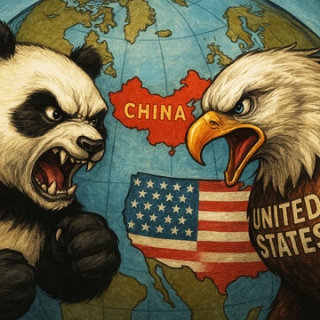
China warned the Trump administration on Tuesday against reigniting trade tension by restoring tariffs on its goods next month, and threatened to retaliate against nations that strike deals with the United States to cut China out of supply chains.
Washington and Beijing agreed to a trade framework in June that restored a fragile truce, but with many details still unclear, traders and investors on both sides of the Pacific are watching to see if it will unravel or lead to a lasting detente.
On Monday, President Donald Trump began notifying trade partners of sharply higher U.S. tariffs from August 1, after he delayed all but 10% of his April duties on most countries to give them time to strike deals with the world's largest economy.
China, initially singled out with tariffs exceeding 100%, has until August 12 to reach an agreement with the White House to keep Trump from reinstating additional import curbs imposed during tit-for-tat tariff exchanges in April and May.
"One conclusion is abundantly clear: dialogue and cooperation are the only correct path," the official People's Daily said in a commentary, referring to the exchanges in the current round of China-U.S. trade tension.
The article was signed "Zhong Sheng", or "Voice of China", a term the paper uses to express views on foreign policy.
Reiterating Beijing's view that Trump's tariffs amount to "bullying", the paper added, "Practice has proven that only by firmly upholding principled positions can one truly safeguard one's legitimate rights and interests."
The remarks set the stage for another round of tariff war should Trump stick to what the ruling Communist Party's official daily said was "a so-called 'final deadline.'"
The average U.S. tariff on Chinese exports now stands at 51.1%, while the average Chinese duty on U.S. goods is 32.6%, with both sides covering all their trade, the Peterson Institute for International Economics said.
The paper also took a swipe at regional economies that are considering striking tariff reduction deals with the United States that cut China out of their supply chains.
Last week, Vietnam secured a tariff reduction to 20% from 46% with a deal for goods "transshipped" through it, typically originating from China, to be subjected to a levy of 40%.
"China firmly opposes any side striking a deal that sacrifices Chinese interests in exchange for tariff concessions," the paper said.
"If such a situation arises, China will not accept it and will respond resolutely to protect its legitimate interests."
Source: Investing.com
Renewed tensions between the United States and Russia have resurfaced following an incident involving an oil tanker, sparking market concerns about potential disruptions to global energy supplies. Was...
According to a report from the US Department of Labor (DOL) released on Thursday, the number of Americans filing new applications for unemployment insurance rose to 208,000 for the week ending January...
Geopolitical issues have heated up again after statements and political signals from the United States sparked speculation about a possible US takeover of Greenland. Although no concrete action has be...
Private employment rose less than economists expected in December, according to the ADP report. Private employment rose 41,000 (Estimate +50,000) in December, compared with a revised -29,000 in Novem...
Greenland is not only a strategic location, but also a world-class mineral repository. The island holds vast reserves of rare earth elements (REEs), essential for modern technology. These minerals are...
Oil prices stabilized on Thursday (February 12th), as the market reassigned a risk premium to US-Iran tensions despite US inventory data showing swelling domestic supplies. This movement confirms one thing: geopolitical headlines are still more...
Gold prices weakened slightly on Thursday (February 12th), as more solid US employment data reduced market confidence in an imminent Federal Reserve interest rate cut. The strong employment data prompted market participants to shift expectations of...
The Hang Seng Index reversed its downward trend in Hong Kong on Thursday (February 12th), weakening by around 0.9% to around 27,000 after a strong session earlier. This decline halted the momentum of the short term rally, as investors began to...