


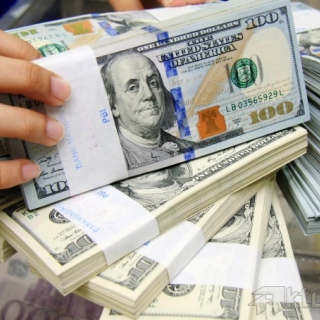
The U.S. dollar fell on Tuesday after President Donald Trump announced a ceasefire between Israel and Iran, in news that sparked a risk rally and a sharp drop in oil prices.
Trump announced a complete ceasefire between Israel and Iran, potentially ending the 12-day conflict that led millions of people to flee Tehran and prompted fears of further escalation in the war-torn region.
Israel has agreed to Trump's proposal, saying it has achieved its goal of removing Tehran's nuclear and ballistic missile threat.
The yen and euro benefited from a sharp fall in oil prices as both the European Union and Japan rely heavily on imports of oil and liquefied natural gas, while the U.S. is a net exporter.
Against the yen, the dollar was down 0.75% at 145.03.
The euro rose 0.27% to $1.1609. It hit $1.1632 a couple of weeks ago, its highest level since October 2021.
Adding to the pressure on the dollar were dovish comments from Federal Reserve policymaker Michelle Bowman, who said the U.S. central bank should consider interest rate cuts soon, triggering a fall in U.S. Treasury yields.
Fed Governor Christopher Waller said in a television interview last week that he would consider a rate cut at next month's meeting as well.
Markets are now pricing in close to a 23% chance the Fed could ease rates in July, up from 14.5% a day ago, according to the CME FedWatch tool.
Against a basket of currencies, the dollar was down 0.14% at 98.09, extending its more than 0.5% decline in the previous session.
Fed Chair Jerome Powell is due to testify before the U.S. Congress on Tuesday and Wednesday, where focus will be on the outlook for U.S. rates.
The risk-sensitive Australian dollar got a lift and last traded 0.7% higher at $0.6506 as did the New Zealand currency, which rose 0.75% to $0.6025.
In cryptocurrencies, bitcoin rose 2% to $105,832, while ether jumped 3.2% to $2,425, in a reflection of the positive risk sentiment.
Source: Reuters
The USD/CHF pair weakened for the third consecutive day and traded around 0.7960 in early European trading on Tuesday. The Swiss franc strengthened on increased demand for safe haven assets, following...
The US Dollar Index (DXY) trended sluggishly around 99.06 on Monday (January 19th), as liquidity thinned as US markets were closed for Martin Luther King Jr. Day. Despite limited movement, global sent...
The US dollar is expected to rise for a third straight day on Thursday (January 8), but trading remains cautious as investors position themselves ahead of Friday's Nonfarm Payrolls (NFP) report. Recen...
The dollar index edged up to 98.5 on Tuesday, its strongest level in more than two weeks, as investors focused on a slate of key economic data for the US. Recent indicators have pointed to some soften...
The US dollar opened 2026 weakly on Friday. Throughout last year, the dollar was pressured by many major currencies due to narrowing interest rate differentials between the US and other countries. Con...
Oil prices stabilized on Thursday (February 12th), as the market reassigned a risk premium to US-Iran tensions despite US inventory data showing swelling domestic supplies. This movement confirms one thing: geopolitical headlines are still more...
Gold prices weakened slightly on Thursday (February 12th), as more solid US employment data reduced market confidence in an imminent Federal Reserve interest rate cut. The strong employment data prompted market participants to shift expectations of...
The Hang Seng Index reversed its downward trend in Hong Kong on Thursday (February 12th), weakening by around 0.9% to around 27,000 after a strong session earlier. This decline halted the momentum of the short term rally, as investors began to...