


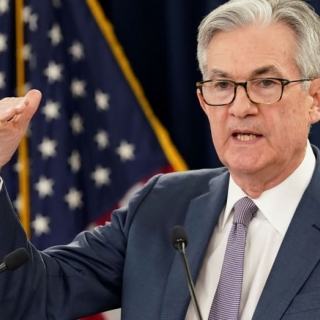
Fed Chairman Jerome Powell hinted that the central bank may stop shrinking its balance sheet in the coming months.
The Fed chairman also indicated that the labor market outlook continues to deteriorate, a message that supports investor expectations for another interest rate cut this month.
"Our long-held plan is to stop shrinking the balance sheet when foreign exchange reserves are slightly above a level we judge to be consistent with adequate foreign exchange reserve conditions," Powell said Tuesday in prepared remarks for an event with the National Association for Business Economics in Philadelphia.
"We will likely reach that point in the coming months, and we are closely monitoring a variety of indicators to inform this decision," Powell said.
Fed officials have been reducing the central bank's balance sheet since 2022—a process known as quantitative tightening—reversing trillions of dollars in asset purchases designed to stimulate the economy after the pandemic struck. Earlier this year, the Fed slowed the pace by reducing the amount of bond holdings it allows to roll over each month. As bank reserves decline, there has been a persistent funding squeeze in the US money market, suggesting the central bank may be getting closer to reaching a point where it wants to halt the flow of funds.
On Tuesday, Powell acknowledged that there have been "some signs" of gradual tightening. "The committee's plan sets out a deliberately cautious approach to avoid money market stress like that experienced in September 2019," he said, referring to a period of market volatility known as the "taper tantrum."
Fed officials appear divided on how low they can take bank reserves while avoiding market volatility. Fed Vice Chair for Supervision Michelle Bowman said in late September that the Fed should strive for the smallest possible balance sheet, with reserve balances at a level closer to scarcity than sufficiency. Governor Christopher Waller has said that the optimal reserve level is around $2.7 trillion.
Interest on Reserves
Powell also argued that the Fed's primary tool for implementing monetary policy—paying interest on reserves held by commercial banks at the central bank—is working well. These interest payments have been a focus of concern for some Washington lawmakers this year.
Powell said the tool allows the central bank to "precisely" calibrate its monetary policy stance.
The tool was approved by lawmakers nearly two decades ago to support the financial system and was used during the Global Financial Crisis. It has become an integral part of the Fed's ability to control short-term interest rates.
"If our ability to pay interest on reserves and other liabilities were eliminated, the Fed would lose control of interest rates," Powell said. "The bottom line is that our abundant reserve regime has proven to be a highly effective way of implementing monetary policy and supporting economic and financial stability."
Powell said in June that a proposal to eliminate the IORB would not save money, and returning to a scarce reserve regime would be challenging and risk volatility. The U.S. Senate last week rejected an amendment that would have prohibited the Fed from paying interest on bank reserves by a vote of 14-83. (alg)
Source: Bloomberg
Stephen Miran, a Federal Reserve governor whose term ends at the end of January, said Thursday that he is looking for 150 basis points of interest-rate cuts this year to boost the U.S. labor market. ...
Federal Reserve Vice Chair for Supervision Michelle Bowman outlined significant changes to bank supervision and regulation during a speech at the California Bankers Association Bank Presidents Seminar...
Further changes to the Federal Reserve's short-term interest rate will need to be "finely tuned" to incoming data given the risks to both the U.S. central bank's employment and inflation goals, Richmo...
Richmond Federal Reserve Bank President Tom Barkin said the monetary policy outlook remains in a fragile balance given the conflicting pressures of rising unemployment and persistently high inflation....
The US Federal Reserve agreed to cut interest rates at its December meeting only after a highly nuanced debate about the current risks facing the US economy, according to minutes from the two-day meet...
Oil prices stabilized on Thursday (February 12th), as the market reassigned a risk premium to US-Iran tensions despite US inventory data showing swelling domestic supplies. This movement confirms one thing: geopolitical headlines are still more...
Gold prices weakened slightly on Thursday (February 12th), as more solid US employment data reduced market confidence in an imminent Federal Reserve interest rate cut. The strong employment data prompted market participants to shift expectations of...
The Hang Seng Index reversed its downward trend in Hong Kong on Thursday (February 12th), weakening by around 0.9% to around 27,000 after a strong session earlier. This decline halted the momentum of the short term rally, as investors began to...