


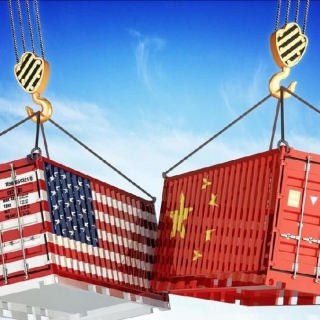
Even as a U.S.–China trade truce appears to be holding, analysts caution that the détente remains fragile in a rivalry increasingly defined by strategic competition.
A flurry of decisions, outlined in the sweeping trade deal struck by U.S. President Donald Trump with Chinese leader Xi Jinping last month, took effect on Monday, with rollbacks of steep tariffs and export controls.
The U.S. halved fentanyl-linked tariffs on imports from China to 10% and extended for a year a truce that lowered the reciprocal tariff rate from 34% to 10%.
In return, China's Ministry of Commerce rolled back several export restrictions on critical minerals and rare earth materials to the U.S. on Monday. Those curbs, first imposed on Oct. 9, had targeted materials vital for military hardware, semiconductors, and other high-tech industries.
Beijing also reversed retaliatory limits on exports of gallium, germanium, antimony, and other so-called super-hard materials such as synthetic diamonds and boron nitrides. Those measures, introduced in December 2024, were widely seen as a response to Washington's expanded semiconductor export restrictions on China.
Still, Morgan Stanley economists said that Beijing has not unwound the export-control framework it introduced in April likely to maintain a "calibrated choke-point" meant to preserve leverage.
Given the persisting strategic rivalry, "we view rolling negotiations, episodic flare-ups, and policy asymmetry as the new equilibrium," the economists said.
China is also reportedly developing a so-called "validated end-user" system, or VEU, to block rare earth exports to companies with ties to the U.S. military, the Wall Street Journal reported Tuesday, citing unnamed sources.
The system, if strictly implemented, could make it more difficult for automotive and aerospace companies with both civilian and defense clients to import certain Chinese materials, the Journal reported.
Trade thaw
Beijing on Monday added 13 fentanyl precursors to its export control list, requiring a license for shipments to the U.S., Mexico, and Canada.
The Ministry of Commerce also suspended sanctions against five U.S.-linked subsidiaries of South Korea's shipbuilder Hanwha Ocean for a year, while the Ministry of Transport paused measures targeting the U.S. shipping sector, including port fees. The U.S. Trade Representative said Sunday it would suspend its own measures for one year.
US-China talks did not address fundamental issues, especially the weak yuan: Brad Setserwatch now
A stronger yuan will help improve China's global trading relations: Brad Setser
As part of the bilateral agreement, the White House said China agreed to purchase 12 million metric tons of soybeans by the end of this year and 25 million annually over the next three years. Beijing, which has not confirmed those numbers, appeared to have resumed soybean purchases from the U.S. recently, according to Reuters, after shunning them for most parts of this year.
"These steps suggest ‘so far, so good,' but in reality, this is just the beginning," said Wendy Cutler, senior vice president at Asia Society Policy Institute. While there were incentives for both sides to keep the truce in place, such "de-escalatory moves tend to be short-lived," she added.
China's economy, weighed down by the prolonged trade war with Washington, grew 4.8% in the third quarter — its slowest in a year and down from 5.2% in the second quarter.
In a notice Monday, China's State Council announced 13 measures to promote private investment in several major state-dominated industries.
China's push for self-reliance amid "fierce international competition" at last month's top economic plenum was a sign that the leadership is linking growth goals more closely to strategic competition with the U.S., said Neil Thomas, a fellow on Chinese politics at the Asia Society.
"Beijing is not chasing a grand bargain [but] seeking a truce to buy time and build leverage," Thomas added. He added that while Washington and Beijing both prioritize self-reliance over interdependence, Xi is betting that his strategic resolve will outlast Trump's.
Source: CNBC
Renewed tensions between the United States and Russia have resurfaced following an incident involving an oil tanker, sparking market concerns about potential disruptions to global energy supplies. Was...
According to a report from the US Department of Labor (DOL) released on Thursday, the number of Americans filing new applications for unemployment insurance rose to 208,000 for the week ending January...
Geopolitical issues have heated up again after statements and political signals from the United States sparked speculation about a possible US takeover of Greenland. Although no concrete action has be...
Private employment rose less than economists expected in December, according to the ADP report. Private employment rose 41,000 (Estimate +50,000) in December, compared with a revised -29,000 in Novem...
Greenland is not only a strategic location, but also a world-class mineral repository. The island holds vast reserves of rare earth elements (REEs), essential for modern technology. These minerals are...
Oil prices stabilized on Thursday (February 12th), as the market reassigned a risk premium to US-Iran tensions despite US inventory data showing swelling domestic supplies. This movement confirms one thing: geopolitical headlines are still more...
Gold prices weakened slightly on Thursday (February 12th), as more solid US employment data reduced market confidence in an imminent Federal Reserve interest rate cut. The strong employment data prompted market participants to shift expectations of...
The Hang Seng Index reversed its downward trend in Hong Kong on Thursday (February 12th), weakening by around 0.9% to around 27,000 after a strong session earlier. This decline halted the momentum of the short term rally, as investors began to...