


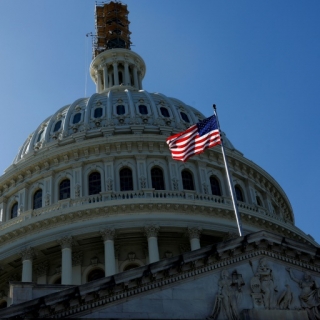
The U.S. Senate will vote again on Friday on conflicting plans between Democrats and Republicans to end the government shutdown, which is now entering its third day, though there are no signs that either plan will pass.
Lawmakers appear to have made no progress toward a deal that would allow them to continue funding the government, and Democrats and Republicans have spent the past few days blaming each other for their failure to maintain government funding beyond October 1, the start of the fiscal year.
Democrats say any funding package must also extend pandemic-era healthcare subsidies that are set to expire at the end of December, while Republicans say the issue should be addressed separately.
Meanwhile, U.S. President Donald Trump has frozen billions of dollars allocated to Democratic-leaning states and threatened to lay off more federal employees, in addition to the 300,000 already forced out by the end of the year. His budget chief, Russ Vought, has asked federal agencies to develop layoff plans for those whose jobs do not align with the administration's priorities.
The government shutdown, the 15th since 1981, has suspended scientific research, economic data reporting, financial regulation, and a variety of other activities. Paychecks have been suspended for approximately 2 million federal employees, although troops, airport security officers, and others deemed "essential" are still required to work.
A prolonged government shutdown could disrupt air travel, disrupt food aid for millions of Americans, and force federal courts to close. Federal employees will miss their first paychecks in mid-October if the impasse is not resolved by then.
The longest government shutdown lasted 35 days in 2018-2019, during Trump's first term. The Senate has three times rejected the Republican plan, which would fund the government through November 21, and the Democratic alternative, which would also strengthen expiring health care subsidies. The Senate will vote again on both plans on Friday.
Republicans control both houses of Congress, but they need at least seven Democratic votes to pass a budget bill in the Senate. A group of senators from both parties said they have been exploring a compromise.
However, some Democrats said they don't believe Republicans will honor any agreement that would reopen the government first and then address healthcare subsidies, which were passed as part of the 2021 Democratic COVID relief package and now help 24 million Americans pay for insurance. (alg)
Source: Reuters
Renewed tensions between the United States and Russia have resurfaced following an incident involving an oil tanker, sparking market concerns about potential disruptions to global energy supplies. Was...
According to a report from the US Department of Labor (DOL) released on Thursday, the number of Americans filing new applications for unemployment insurance rose to 208,000 for the week ending January...
Geopolitical issues have heated up again after statements and political signals from the United States sparked speculation about a possible US takeover of Greenland. Although no concrete action has be...
Private employment rose less than economists expected in December, according to the ADP report. Private employment rose 41,000 (Estimate +50,000) in December, compared with a revised -29,000 in Novem...
Greenland is not only a strategic location, but also a world-class mineral repository. The island holds vast reserves of rare earth elements (REEs), essential for modern technology. These minerals are...
Oil prices stabilized on Thursday (February 12th), as the market reassigned a risk premium to US-Iran tensions despite US inventory data showing swelling domestic supplies. This movement confirms one thing: geopolitical headlines are still more...
Gold prices weakened slightly on Thursday (February 12th), as more solid US employment data reduced market confidence in an imminent Federal Reserve interest rate cut. The strong employment data prompted market participants to shift expectations of...
The Hang Seng Index reversed its downward trend in Hong Kong on Thursday (February 12th), weakening by around 0.9% to around 27,000 after a strong session earlier. This decline halted the momentum of the short term rally, as investors began to...