


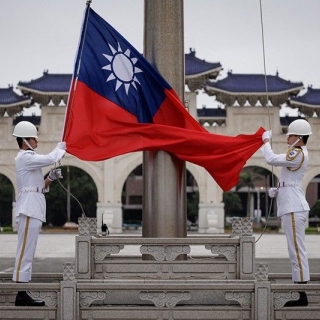
China is intentionally mischaracterising World War Two-era documents to put pressure on, and isolate, Taiwan, as those accords made no determination of the island's ultimate political status, the de facto U.S. embassy in Taipei said.
The 80th anniversary of the war's end has been marked by a bitter dispute between Taipei and Beijing on its broader historical meaning and relevance today.
Beijing says documents such as the Cairo Declaration and Potsdam Proclamation support its legal claims of sovereignty over the island, as they call for Taiwan to be "restored" to Chinese rule at a time when it was a colony of Japan.
The Chinese government at the time was the Republic of China, which fled in 1949 to Taiwan after losing a subsequent civil war with Mao Zedong's communists.
The Republic of China remains Taiwan's formal name, and its government says no World War Two agreements made any mention of Mao's People's Republic of China because it did not exist then, so that Beijing has no right to claim Taiwan now.
"China intentionally mischaracterises World War Two-era documents, including the Cairo Declaration, the Potsdam Proclamation, and the Treaty of San Francisco, to try to support its coercive campaign to subjugate Taiwan," the American Institute in Taiwan said in an statement on Monday.
"Beijing's narratives are simply false, and none of these documents determined Taiwan's ultimate political status," the de facto U.S. embassy added in the statement emailed to Reuters.
Japan signed the San Francisco Peace Treaty in 1951, renouncing its claims to Taiwan, though the island's sovereignty is left unresolved in that pact. Beijing says the treaty is "illegal and invalid", as it was not a party to it.
China's foreign ministry expressed "strong dissatisfaction" at Monday's comments, saying they were misleading.
"A series of documents with legal effect, such as the Cairo Declaration and the Japanese surrender document, clearly confirm China's sovereignty over Taiwan and the status of Taiwan," ministry spokesperson Lin Jian said in Beijing.
The United States ended official ties with Taipei in 1979 when it recognised Beijing, but remains the island's most important international backer.
Washington follows a "one China policy" by which it officially takes no position on Taiwan's sovereignty and only acknowledges China's position on the subject.
"False legal narratives are part of Beijing's broader campaign to try to isolate Taiwan from the international community and constrain the sovereign choices of other countries regarding their interactions with Taiwan," added the American Institute in Taiwan.
Taiwan Foreign Minister Lin Chia-lung expressed his thanks for the U.S. mission's statement.
"Our country and the People's Republic of China are not subordinate to each other, and the People's Republic of China has no right to represent Taiwan in the international community," Lin said in a statement.
On September 3, Chinese President Xi Jinping oversaw a massive military parade in Beijing to mark the war anniversary.
Source: Investing.com
Renewed tensions between the United States and Russia have resurfaced following an incident involving an oil tanker, sparking market concerns about potential disruptions to global energy supplies. Was...
According to a report from the US Department of Labor (DOL) released on Thursday, the number of Americans filing new applications for unemployment insurance rose to 208,000 for the week ending January...
Geopolitical issues have heated up again after statements and political signals from the United States sparked speculation about a possible US takeover of Greenland. Although no concrete action has be...
Private employment rose less than economists expected in December, according to the ADP report. Private employment rose 41,000 (Estimate +50,000) in December, compared with a revised -29,000 in Novem...
Greenland is not only a strategic location, but also a world-class mineral repository. The island holds vast reserves of rare earth elements (REEs), essential for modern technology. These minerals are...
Oil prices stabilized on Thursday (February 12th), as the market reassigned a risk premium to US-Iran tensions despite US inventory data showing swelling domestic supplies. This movement confirms one thing: geopolitical headlines are still more...
Gold prices weakened slightly on Thursday (February 12th), as more solid US employment data reduced market confidence in an imminent Federal Reserve interest rate cut. The strong employment data prompted market participants to shift expectations of...
The Hang Seng Index reversed its downward trend in Hong Kong on Thursday (February 12th), weakening by around 0.9% to around 27,000 after a strong session earlier. This decline halted the momentum of the short term rally, as investors began to...