


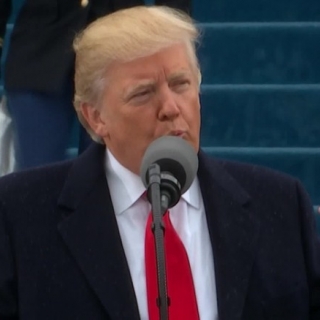
Donald Trump's $3.3 trillion tax-cutting and spending bill passed the Senate on Tuesday after Republican leaders worked hard to persuade opponents to support the legislation and hand the president a political victory.
Senators voted 51-50 to pass the bill. Vice President J.D. Vance cast the tie-breaking vote. The package, which now goes to the House, combines $4.5 trillion in tax cuts with $1.2 trillion in spending cuts.
The package — informally known as the "One Big Beautiful Bill" — encompasses the president's entire legislative agenda in one package. Trump has personally lobbied lawmakers to quickly push the legislation through Congress.
Republicans say passing the bill would help them maintain their congressional majorities in the midterm elections.
Polls, however, show that the bill is not very popular. A recent Pew Research survey found that 49% of Americans oppose the bill, while 29% support it. About 21% are unsure what to think. The House is expected to vote on the bill this week, but its success is not guaranteed. Only a handful of Republicans could get the bill to pass despite unified Democratic opposition. Conservatives there say they are still pushing for more spending cuts, while moderates have expressed concern about the Senate bill's cuts to Medicaid and other social safety net programs.
The Senate bill would raise the state and local tax deduction from $10,000 to $40,000 for just five years, drawing opposition from a New York Republican who called it inadequate. The cuts to hospital payments have prompted others to voice their opposition. Any changes in the House would force the Senate to take up the bill again, thwarting Trump's plan to sign it by July 4.
Trump's Agenda
Republicans say the legislation would boost the economy, curb illegal immigration and begin the process of cutting waste in Medicaid and other welfare programs. The tax cut bill would avoid a major tax hike for individuals early next year when Trump's 2017 tax cuts expire and would permanently extend some business tax breaks that have already partially expired, which the president has said will help boost economic growth.
But many economists have warned that the bill would do little to boost the economy and worsen the country's fiscal woes.
"The fiscal path of the United States is unsustainable," Federal Reserve Chairman Jay Powell said Tuesday. "The debt level is sustainable but the path is not, and we need to address it sooner rather than later. Sooner is better than later." At Trump's request, the bill adds new tax breaks for tips, auto loans and overtime, and expands tax breaks for seniors and the elderly that he promoted on the campaign trail.
The new tax cuts are funded by a major cut to renewable energy, a move that would ultimately benefit the fossil fuel industry. The popular electric vehicle tax credit would be eliminated, something that has drawn ire from Trump's former staunch ally Elon Musk, whose Tesla Inc. would suffer. The bill would send hundreds of billions in new funding to the military, reinforcing Trump's emphasis on hard power over foreign aid, which he has slashed. It would also boost funding for immigration enforcement.
The costly tax cuts and spending increases are partly paid for by spending cuts that are primarily targeted at Medicaid, food stamps and federal student loans. Democrats say the cuts to anti-poverty programs combined with tax cuts that disproportionately benefit the wealthy make the bill deeply regressive.
They also point to a $3.3 trillion increase in the deficit over a decade despite GOP claims of fiscal responsibility. Nearly $1 trillion would be cut from Medicaid by imposing new work requirements for able-bodied adults without children, imposing copayments and limiting federal reimbursements to states. Food stamp work requirements would be expanded and states with error-prone systems would be penalized. (alg)
Source: Bloomberg
Renewed tensions between the United States and Russia have resurfaced following an incident involving an oil tanker, sparking market concerns about potential disruptions to global energy supplies. Was...
According to a report from the US Department of Labor (DOL) released on Thursday, the number of Americans filing new applications for unemployment insurance rose to 208,000 for the week ending January...
Geopolitical issues have heated up again after statements and political signals from the United States sparked speculation about a possible US takeover of Greenland. Although no concrete action has be...
Private employment rose less than economists expected in December, according to the ADP report. Private employment rose 41,000 (Estimate +50,000) in December, compared with a revised -29,000 in Novem...
Greenland is not only a strategic location, but also a world-class mineral repository. The island holds vast reserves of rare earth elements (REEs), essential for modern technology. These minerals are...
Oil prices stabilized on Thursday (February 12th), as the market reassigned a risk premium to US-Iran tensions despite US inventory data showing swelling domestic supplies. This movement confirms one thing: geopolitical headlines are still more...
Gold prices weakened slightly on Thursday (February 12th), as more solid US employment data reduced market confidence in an imminent Federal Reserve interest rate cut. The strong employment data prompted market participants to shift expectations of...
The Hang Seng Index reversed its downward trend in Hong Kong on Thursday (February 12th), weakening by around 0.9% to around 27,000 after a strong session earlier. This decline halted the momentum of the short term rally, as investors began to...