


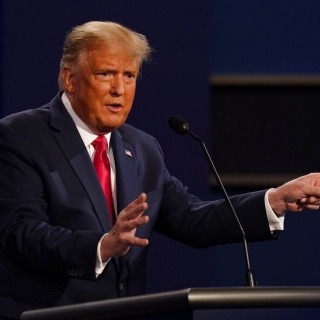
The United States said Tuesday that 104% tariffs on Chinese imports would go into effect shortly after midnight, even as the Trump administration moved quickly to begin talks with other trading partners targeted by President Donald Trump's sweeping tariff plans.
U.S. stocks slumped on the news. Global markets had earlier posted gains on hopes that Trump might be willing to negotiate a series of country- and product-specific trade barriers he has built around the world's largest consumer market.
The administration has scheduled talks with South Korea and Japan, two close allies and major trading partners, and Italian Prime Minister Giorgia Meloni is due to visit next week.
But the White House said the country-specific tariffs of up to 50% would go into effect at 12:01 a.m. Eastern Time (0401 GMT), as planned. The tariffs would be particularly high for China, as Trump has already raised tariffs on its imports to 104 percent in response to retaliatory tariffs announced by Beijing last week. China has refused to bow to what it calls "blackmail" and has vowed to "fight to the end." Administration officials have said they will not prioritize negotiations with the world's No. 2 economy.
Trump's sweeping tariffs have raised fears of a recession and upended a global trade order that has been in place for decades. "Right now, we have been instructed to prioritize our allies and trading partners like Japan and Korea and others," White House economic adviser Kevin Hassett said on Fox News. The White House said Trump instructed his trade team to work out "tailor-made" deals for the nearly 70 countries that have reached out to talk.
Trump's top trade negotiator, Jamieson Greer, told Congress that his office was trying to work quickly but did not have a specific deadline. "The president has made it clear, once again, that he is not going to grant waivers or exemptions anytime soon," Greer told lawmakers.
China is bracing for a war of attrition, with manufacturers warning about profits and scrambling to plan new factories overseas. Citing rising external risks, Citi cut its 2025 GDP growth forecast for China to 4.2% from 4.7%. (Newsmaker23)
Source: Reuters
Renewed tensions between the United States and Russia have resurfaced following an incident involving an oil tanker, sparking market concerns about potential disruptions to global energy supplies. Was...
According to a report from the US Department of Labor (DOL) released on Thursday, the number of Americans filing new applications for unemployment insurance rose to 208,000 for the week ending January...
Geopolitical issues have heated up again after statements and political signals from the United States sparked speculation about a possible US takeover of Greenland. Although no concrete action has be...
Private employment rose less than economists expected in December, according to the ADP report. Private employment rose 41,000 (Estimate +50,000) in December, compared with a revised -29,000 in Novem...
Greenland is not only a strategic location, but also a world-class mineral repository. The island holds vast reserves of rare earth elements (REEs), essential for modern technology. These minerals are...
Oil prices stabilized on Thursday (February 12th), as the market reassigned a risk premium to US-Iran tensions despite US inventory data showing swelling domestic supplies. This movement confirms one thing: geopolitical headlines are still more...
Gold prices weakened slightly on Thursday (February 12th), as more solid US employment data reduced market confidence in an imminent Federal Reserve interest rate cut. The strong employment data prompted market participants to shift expectations of...
The Hang Seng Index reversed its downward trend in Hong Kong on Thursday (February 12th), weakening by around 0.9% to around 27,000 after a strong session earlier. This decline halted the momentum of the short term rally, as investors began to...