


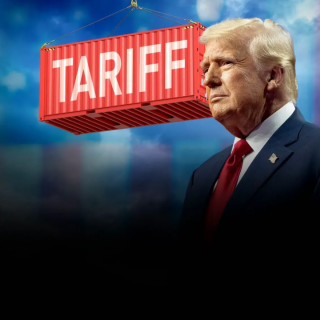
President Donald Trump confirmed Monday that tariffs on Mexico, and Canada are set to go ahead on Tuesday as both nations have now run out of room to negotiate a deal.
Starting on Tuesday, all imported products from Canada and Mexico will be subject to 25% import duties. Trump has pointed to the lack of effort from Mexico and Canada to shore up their borders with the U.S. to stem the flow of the "vast amounts" of fentanyl that have poured into the United States.
"No room left for Mexico or for Canada," the president told reporters at the White House. "The tariffs, you know, they're all set. They go into effect tomorrow."
In addition to the Mexico and Canada tariffs, Trump announced an additional 10% tariff on China, bringing the rate to 20%.
Commenting on the news, Morgan Stanley U.S. public policy strategist Michael Zezas said that while an eleventh-hour deal could still happen, the firm's economists believe that fully implemented tariffs would have meaningful consequences.
"A recession in Mexico becomes the base case," Zezas states. "US inflation could be 0.3 to 0.6pp higher vs baseline over the next 3-4 months (putting headline PCE inflation at 2.9% to 3.2%), and US growth could be - 0.7 to -1.1pp lower vs baseline over the next 3-4 quarters (putting real GDP growth at 1.2% to 1.6%)."
Meanwhile, Morgan Stanley's rates strategists are bullish duration, even more so if the U.S. follows through with tariffs. "In the event these tariffs come on, we expect investors focus on the increased downside risks to growth expectations," the strategist says. "This takes place with a more dovish repricing of the trough policy rate, which also reprices lower further out the curve."
They note sectors in the market at most risk from the increased tariffs are IT Hardware and Equipment, Autos, and subsets of Consumer.
Zezas goes on to say that from a policy perspective, many outcomes are still possible.
"President Trump could speak with leaders of Mexico/Canada and agree to another postponement (quick resolution), the tariffs could go on as scheduled & be removed after a short period of time (limited scope/duration), or the tariffs could prove broad-based and durable, which would have the greatest impact for the economy & markets," the strategist commented. "We expect the bar to clear to avoiding tariffs is lower for Mexico and Canada, as leaders of both countries have noted progress in key issues like immigration & fentanyl. We expect the tariffs on China are "stickier", but note the fluidity with which we could move between paths from here."
Source: Investing.com
Renewed tensions between the United States and Russia have resurfaced following an incident involving an oil tanker, sparking market concerns about potential disruptions to global energy supplies. Was...
According to a report from the US Department of Labor (DOL) released on Thursday, the number of Americans filing new applications for unemployment insurance rose to 208,000 for the week ending January...
Geopolitical issues have heated up again after statements and political signals from the United States sparked speculation about a possible US takeover of Greenland. Although no concrete action has be...
Private employment rose less than economists expected in December, according to the ADP report. Private employment rose 41,000 (Estimate +50,000) in December, compared with a revised -29,000 in Novem...
Greenland is not only a strategic location, but also a world-class mineral repository. The island holds vast reserves of rare earth elements (REEs), essential for modern technology. These minerals are...
Oil prices stabilized on Thursday (February 12th), as the market reassigned a risk premium to US-Iran tensions despite US inventory data showing swelling domestic supplies. This movement confirms one thing: geopolitical headlines are still more...
Gold prices weakened slightly on Thursday (February 12th), as more solid US employment data reduced market confidence in an imminent Federal Reserve interest rate cut. The strong employment data prompted market participants to shift expectations of...
The Hang Seng Index reversed its downward trend in Hong Kong on Thursday (February 12th), weakening by around 0.9% to around 27,000 after a strong session earlier. This decline halted the momentum of the short term rally, as investors began to...