


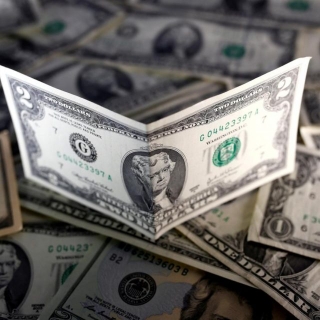
The dollar rose on Thursday, boosted by safe-haven demand amid the threat of a wider conflict in the Middle East and possible U.S. involvement, while investors weighed Federal Reserve Chairman Jerome Powell's warning tone on inflation.
After a quiet start in Asian hours, the dollar strengthened across the board, weighing on risk-sensitive currencies after a report said U.S. officials were preparing for a possible attack on Iran in the coming days.
The Australian dollar fell as much as 0.5% but was last down 0.3% at $0.6489, while the New Zealand dollar fell 0.5% to $0.5998. Emerging-market currencies also struggled, with the South Korean won weakening 1%.
The rapidly escalating geopolitical tensions have caused the dollar to quickly regain its safe-haven status, making inroads against the yen, euro and Swiss franc.
Iran and Israel exchanged airstrikes on Thursday, as the conflict entered its seventh day. Concerns over potential U.S. involvement have also grown, as President Donald Trump has left the world wondering whether the United States will join Israel in bombing Iran's nuclear sites.
The conflict has raised concerns about wider regional instability, compounded by spillover effects from the Gaza war.
Some analysts say investors are looking to cover their short positions.
"The dollar looks set for a short-covering rally — especially if the U.S. gets involved in a Middle East conflict," said Matt Simpson, senior analyst at City Index.
Geopolitical concerns appear to have overshadowed the FOMC outcome, according to Christopher Wong, currency strategist at OCBC. "Risk aversion is dominating sentiment, and that's putting pressure on risk-sensitive FX."
U.S. markets are closed on Thursday for the Juneteenth federal holiday, which has led to lower liquidity.
The euro hit a one-week low and was last down 0.25% at $1.1455, heading for a 0.8% drop this week, its biggest weekly decline since February. The yen last stood at 145.13 per dollar.
The dollar index, which measures the currency against six other units, rose 0.11% to 99 and was set for a gain of about 0.9% for the week, its strongest weekly performance since late January. (alg)
Source: Reuters
The USD/CHF pair weakened for the third consecutive day and traded around 0.7960 in early European trading on Tuesday. The Swiss franc strengthened on increased demand for safe haven assets, following...
The US Dollar Index (DXY) trended sluggishly around 99.06 on Monday (January 19th), as liquidity thinned as US markets were closed for Martin Luther King Jr. Day. Despite limited movement, global sent...
The US dollar is expected to rise for a third straight day on Thursday (January 8), but trading remains cautious as investors position themselves ahead of Friday's Nonfarm Payrolls (NFP) report. Recen...
The dollar index edged up to 98.5 on Tuesday, its strongest level in more than two weeks, as investors focused on a slate of key economic data for the US. Recent indicators have pointed to some soften...
The US dollar opened 2026 weakly on Friday. Throughout last year, the dollar was pressured by many major currencies due to narrowing interest rate differentials between the US and other countries. Con...
Oil prices stabilized on Thursday (February 12th), as the market reassigned a risk premium to US-Iran tensions despite US inventory data showing swelling domestic supplies. This movement confirms one thing: geopolitical headlines are still more...
Gold prices weakened slightly on Thursday (February 12th), as more solid US employment data reduced market confidence in an imminent Federal Reserve interest rate cut. The strong employment data prompted market participants to shift expectations of...
The Hang Seng Index reversed its downward trend in Hong Kong on Thursday (February 12th), weakening by around 0.9% to around 27,000 after a strong session earlier. This decline halted the momentum of the short term rally, as investors began to...