


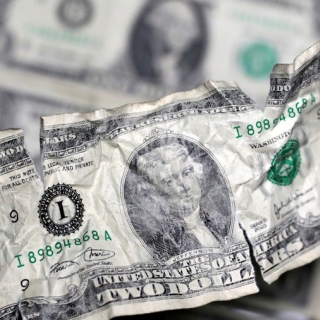
The dollar fell for a third day against a range of currencies on Wednesday, after U.S. President Donald Trump failed to convince Republican holdouts to back his sweeping tax bill.
Traders were also wary of U.S. officials potentially angling for a weaker dollar at Group of Seven finance minister meetings under way in Canada.
Developments in Trump's global tariff war, which have swung currencies wildly in recent months, have slowed considerably this week, even as the clock ticks to the end of a 90-day tariff respite for U.S. trade partners in the absence of new deals.
While markets remain optimistic that the White House is eager to get trade flowing again on a sustained basis, talks with close allies Tokyo and Seoul appear to have lost momentum.
All this has combined to keep the dollar under pressure and U.S. Treasury yields rising, as the "sell America" theme continues to inform investment decisions, if in a less dramatic fashion than earlier this month.
"We do not consider the USD - and U.S. assets generally - are at the start of a 'death spiral'," Commonwealth Bank of Australia analysts wrote in a note.
"However, we forecast the USD to re‑weaken in 2026 once the tariff uncertainty fades and lower interest rates support a recovery in the world economy," they said. "Additionally, we expect large money managers to allocate less capital to USD assets over time."
A Moody's downgrade of the U.S. sovereign debt rating on Friday may have had only a limited impact on markets, but it has added to the narrative of less faith in U.S. assets as safe havens. As a result, the dollar is down on the year against every major currency .
Trump's tax bill would add $3 trillion to $5 trillion to the country's debt, according to nonpartisan analysts. Ballooning fiscal debt, trade frictions, and weakened confidence have weighed on U.S. markets.
"Tariff rates are now lower, but not low, and the same can be said about recession risks in the U.S.," Goldman Sachs analysts wrote in a research note.
"The U.S. still faces the worst growth-inflation mix of the major economies, and as the fiscal bill makes its way through Congress, eroding U.S. exceptionalism is proving - literally - costly at a time of large funding needs."
An auction of 20-year Treasuries later might offer a litmus test of investor appetite for long-dated U.S. debt.
Japanese Finance Minister Katsunobu Kato said ahead of an expected meeting with U.S. Treasury Secretary Scott Bessent that talks on exchange rates would be based on their shared view that excessive volatility is undesirable.
"While market participants do not expect any explicit comment from Bessent on a shift in Washington policy on the dollar, any sign of pushing trading partners in Asia ... to conducting less or stopping U.S. dollar-buying intervention would likely trigger further big moves weaker for the dollar," MUFG strategist Derek Halpenny said.
The yen strengthened against the dollar, which fell 0.6% to 143.595 yen, extending gains derived in part from a steep rise this week in domestic bond yields .
Source: Reuters
The USD/CHF pair weakened for the third consecutive day and traded around 0.7960 in early European trading on Tuesday. The Swiss franc strengthened on increased demand for safe haven assets, following...
The US Dollar Index (DXY) trended sluggishly around 99.06 on Monday (January 19th), as liquidity thinned as US markets were closed for Martin Luther King Jr. Day. Despite limited movement, global sent...
The US dollar is expected to rise for a third straight day on Thursday (January 8), but trading remains cautious as investors position themselves ahead of Friday's Nonfarm Payrolls (NFP) report. Recen...
The dollar index edged up to 98.5 on Tuesday, its strongest level in more than two weeks, as investors focused on a slate of key economic data for the US. Recent indicators have pointed to some soften...
The US dollar opened 2026 weakly on Friday. Throughout last year, the dollar was pressured by many major currencies due to narrowing interest rate differentials between the US and other countries. Con...
Oil prices stabilized on Thursday (February 12th), as the market reassigned a risk premium to US-Iran tensions despite US inventory data showing swelling domestic supplies. This movement confirms one thing: geopolitical headlines are still more...
Gold prices weakened slightly on Thursday (February 12th), as more solid US employment data reduced market confidence in an imminent Federal Reserve interest rate cut. The strong employment data prompted market participants to shift expectations of...
The Hang Seng Index reversed its downward trend in Hong Kong on Thursday (February 12th), weakening by around 0.9% to around 27,000 after a strong session earlier. This decline halted the momentum of the short term rally, as investors began to...