


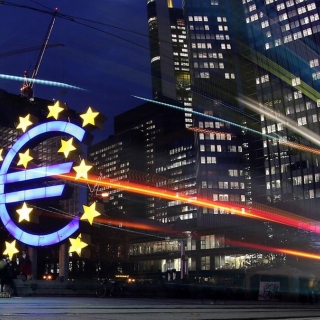
The EUR/USD pair recovers some lost ground to near 1.0425 during the early European trading hours on Thursday. The weakening of the US Dollar (USD) provides some support to the major pair. However, tariff concerns from US President Donald Trump and geopolitical tension might cap its upside.
The ECB sets interest rates and manages monetary policy for the region. The ECB primary mandate is to maintain price stability, which means keeping inflation at around 2%. Its primary tool for achieving this is by raising or lowering interest rates. Relatively high interest rates will usually result in a stronger Euro and vice versa. The ECB Governing Council makes monetary policy decisions at meetings held eight times a year. Decisions are made by heads of the Eurozone national banks and six permanent members, including the President of the ECB, Christine Lagarde.
In extreme situations, the European Central Bank can enact a policy tool called Quantitative Easing. QE is the process by which the ECB prints Euros and uses them to buy assets – usually government or corporate bonds – from banks and other financial institutions. QE usually results in a weaker Euro. QE is a last resort when simply lowering interest rates is unlikely to achieve the objective of price stability. The ECB used it during the Great Financial Crisis in 2009-11, in 2015 when inflation remained stubbornly low, as well as during the covid pandemic.
Quantitative tightening (QT) is the reverse of QE. It is undertaken after QE when an economic recovery is underway and inflation starts rising. Whilst in QE the European Central Bank (ECB) purchases government and corporate bonds from financial institutions to provide them with liquidity, in QT the ECB stops buying more bonds, and stops reinvesting the principal maturing on the bonds it already holds. It is usually positive (or bullish) for the Euro.
Source: Fxstreet
The US dollar weakened at the start of the week after tensions between the United States and the European Union escalated over the Greenland issue. Markets assessed that the political conflict, which ...
EUR/USD loses ground for the sixth consecutive day on Wednesday, trading below 1.1730 after peaking above 1.1800 last week. The pair struggles amid a moderate US Dollar (USD) rebound following the rel...
The EUR/USD pair moved steadily around 1.1750 during Wednesday's Asian session. Its movement appeared to be holding up after a sharp drop the previous day from its highest level since September 24th. ...
The euro rebounded above $1.16, reaching its strongest level since mid-November, as investors adopted a cautious stance ahead of key Eurozone and US economic data that could influence interest rate ex...
The EUR/USD pair traded flat on Thursday, trading around 1.1596, as market liquidity thinned during the US Thanksgiving holiday. Despite the limited movement, pressure on the US dollar remained as exp...
Gold prices briefly caused a stir after hitting a new record, but then slowed. The main trigger: US President Donald Trump withheld the threat of tariffs on Europe and claimed there was a "framework" for a future agreement on Greenland. This calmer...
Oil prices were little changed in Asian trading on Thursday after US President Donald Trump backed down from a threat to impose tariffs on European countries over Greenland. This decision helped ease geopolitical tensions and improve market...
The Nikkei 225 Index climbed 1.73% to close at 53,689, while the broader Topix Index rose 0.74% to 3,616 on Thursday, snapping a five-day losing streak as Japanese shares were lifted by a strong rally in chip and artificial intelligence related...