


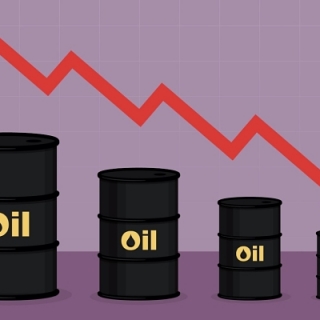
Oil prices settled at their lowest level since early May on Monday as investors weighed the potential for a global oversupply, with U.S.-China trade tensions adding to concerns about an economic slowdown and weakening energy demand.
Brent crude futures closed down 28 cents, or 0.46%, at $61.01 a barrel. U.S. West Texas Intermediate crude futures closed down 2 cents, or 0.03%, at $57.52.
Both benchmarks fell more than $1 earlier in the session, and both closed at their weakest levels since early May. Oil traders' concerns have shifted from undersupply to oversupply, as indicated by the structure of the global benchmark Brent futures contract.
The six-month spread for Brent and US crude oil shows early-loading contracts trading below late-loading contracts, a structure known as contango, which encourages traders to pay storage costs to sell oil at higher prices when supplies are expected to shrink in the future.
The Brent contango, which appeared on Thursday for the first time since a brief appearance in May, is trading at its widest level since December 2023. The US crude contango appeared on Friday for the first time since January 2024.
"These oversupply concerns are now starting to hit the market, especially as we head into 2026. We're going to start seeing floating storage build up and onshore tanks fill up," said John Kilduff, partner at Again Capital. "This is a real bearish narrative that we haven't seen for some time," Kilduff added.
Both crude oil benchmarks fell more than 2% last week, marking their third consecutive weekly decline, partly due to the International Energy Agency's (IEA) projection of a growing oversupply by 2026.
Both futures contracts have spent much of this year in an inverse structure, known as backwardation, where current prices trade at a higher premium to future supply. This reflects perceptions of tight near-term supply and solid demand. (alg)
Source: Reuters
Oil prices were little changed in Asian trading on Thursday after US President Donald Trump backed down from a threat to impose tariffs on European countries over Greenland. This decision helped ease ...
Oil prices rose on Tuesday, supported by a combination of supply disruptions from Kazakhstan, improved global economic growth projections, and a weakening US dollar, making dollar-denominated oil chea...
Oil traded in a tight range on Thursday after two straight sessions of losses, as markets digested a sharper US push to shape Venezuela's crude flows—alongside fresh tanker seizures tied to sanctions....
Oil prices edged higher as the market digested the United States' latest moves regarding Venezuela. WTI held steady at US$56/barrel after a sharp drop, while Brent remained below US$60/barrel. This s...
Brent crude prices sank in volatile trading on Wednesday after U.S. President Donald Trump said Venezuela will supply tens of millions of barrels of oil to Washington. Oil prices were nursing losses ...
Gold prices briefly caused a stir after hitting a new record, but then slowed. The main trigger: US President Donald Trump withheld the threat of tariffs on Europe and claimed there was a "framework" for a future agreement on Greenland. This calmer...
Oil prices were little changed in Asian trading on Thursday after US President Donald Trump backed down from a threat to impose tariffs on European countries over Greenland. This decision helped ease geopolitical tensions and improve market...
The Nikkei 225 Index climbed 1.73% to close at 53,689, while the broader Topix Index rose 0.74% to 3,616 on Thursday, snapping a five-day losing streak as Japanese shares were lifted by a strong rally in chip and artificial intelligence related...