


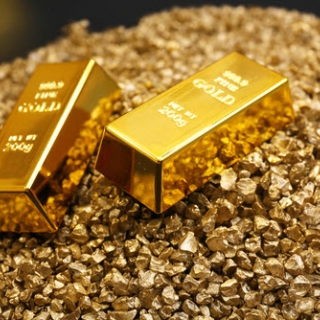
Gold and silver rallied to fresh all-time highs on escalating geopolitical tensions and prospects for more US rate cuts.
Spot silver rose as much as 3.6% to trade above $70 an ounce for the first time. Gold was near $4,500 an ounce, extending gains after its biggest one-day jump in more than a month. Traders are betting the Federal Reserve will follow three straight interest-rate cuts by lowering the cost of borrowing again next year, which would be a tailwind for non-yielding precious metals.
Gold's haven appeal has also been amplified in the last week by rising geopolitical tensions, particularly in Venezuela, where the US has blockaded oil tankers as it ratchets up pressure on the government of President Nicolás Maduro.
"Geopolitical frictions have re-entered the narrative," said Ahmad Assiri, a strategist at Pepperstone Group, citing the oil-tanker seizures. "These developments, while not triggering outright risk-off moves, undoubtedly add to the background demand for gold as a must-have hedge."
Gold prices are up more than two-thirds this year and are on track for the best annual performance since 1979. The rally has been underpinned by elevated central-bank purchases and inflows into exchange-traded funds, with total holdings in gold-backed ETFs rising every month this year except May, according to World Gold Council data.
US President Donald Trump's aggressive moves to reshape global trade — as well as his threats to the Fed's independence — added fuel to the bull run earlier this year. Investors have also been spurred in part by the so-called debasement trade — a retreat from sovereign bonds and the currencies they are denominated in over fears their value will erode over time due to ballooning debt levels.
Heavy ETF buying has been a major driver of the surge. Holdings in State Street Corp.'s SPDR Gold Trust, the biggest precious-metals ETF, have risen by more than a fifth this year.
"Gold ETF inflows over the past few months have been driven largely by retail rather than institutional investors," said Apoorva Javadekar, chief economist at Muthoot Fincorp Ltd. Price volatility will remain elevated as "retail flows are less sticky," he said.
Bullion bounced back after a retreat from its previous peak of $4,381 an ounce in October, when the rally was seen as overheated, and is now positioned to carry these gains into next year. Goldman Sachs Group Inc. is among several banks to predict prices will keep rising in 2026, issuing a base-case scenario of $4,900 an ounce with risks to the upside.
Silver's rally of around 140% this year has been even more spectacular than gold's, with its most recent advance buoyed by speculative inflows and lingering supply dislocations across major trading hubs following a historic short squeeze in October.
India's buyers drew in large shipments of the metal, driven by the Hindu festival of Diwali, while global holdings of silver-backed ETFs keep soaring. That wave of demand collided with tight inventories in the London benchmark market, which was gripped by the supply squeeze.
London's vaults have seen significant inflows since then, but much of the world's available silver remains in New York as traders await the outcome of a US Commerce Department probe on whether critical minerals imports threaten national security, which could lead to tariffs or trade restrictions on the metal.
Meanwhile in China, silver kept in warehouses linked to the Shanghai Futures Exchange last month hit the lowest level since 2015.
Beyond its role as a financial asset, silver is woven into global supply chains — from electronics and solar panels to coatings for medical devices. Global demand for the metal has outpaced output from mines for five consecutive years, according to the Silver Institute, an industry association.
Gold's relative strength index indicates the metal has been bought so heavily it could be due for a pause or pullback, with readings above 80 as of Tuesday. Silver, currently near 80, has been at elevated levels for around two weeks. Readings above 70 typically signal overbought conditions. The 3-month implied volatility of iShares Silver Trust, the world's largest silver ETF, reached the highest since early 2021. However, one measure of bullishness — the ratio of 3-month call to put volatility — slipped to the lowest level since mid October.
This hasn't put off investors: "Instead of sellers stepping in aggressively, both gold and silver continue to attract buying into strength," Pepperstone's Assiri said. "This behavior suggests that $4,500 and $70 are being treated less as hard ceilings and more as reference points within ongoing trends, leaving both metals firmly supported for now and over the holidays."
Spot gold rose 1.1% to $4,491.63 an ounce as of 3:02 p.m. in New York. Silver rose 3.2% to $71.25 an ounce. Platinum and palladium both gained.
Source : Bloomberg.com
Gold prices weakened slightly on Thursday (February 12th), as more solid US employment data reduced market confidence in an imminent Federal Reserve interest rate cut. The strong employment data promp...
Gold prices strengthened on Wednesday, supported by a weaker US dollar and falling US bond yields after the latest economic data reinforced the narrative that the Federal Reserve is likely to continue...
Gold experienced a slight correction in the European session on Tuesday (February 10th), but remained above $5,000/oz as the market held its breath ahead of a series of US data that could alter intere...
Gold held above the psychological $5,000 level at the start of the week, supported by a combination of factors that are "right" for the precious metal : physical demand from China, expectations of low...
Gold prices are still struggling to turn an intraday rebound into a sustained rally. After briefly falling to $4,654 (a four day low) and rebounding, prices were again rejected near $4,900. In the Eur...
Oil prices stabilized on Thursday (February 12th), as the market reassigned a risk premium to US-Iran tensions despite US inventory data showing swelling domestic supplies. This movement confirms one thing: geopolitical headlines are still more...
Gold prices weakened slightly on Thursday (February 12th), as more solid US employment data reduced market confidence in an imminent Federal Reserve interest rate cut. The strong employment data prompted market participants to shift expectations of...
The Hang Seng Index reversed its downward trend in Hong Kong on Thursday (February 12th), weakening by around 0.9% to around 27,000 after a strong session earlier. This decline halted the momentum of the short term rally, as investors began to...