


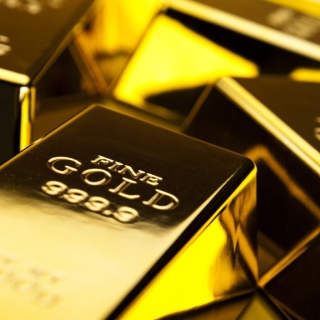
Gold fell after a three-day rally as US President Donald Trump's deal with Japan and reports of progress in negotiations with the European Union eased trade war fears that had fueled demand for safe-haven assets.
Bullion fell as much as 1.4% after Trump said he would impose 15% tariffs on Japanese goods, while the Financial Times reported that the US and EU were close to reaching a similar agreement. The terms with Japan were better than most investors had expected, following tough negotiations.
Commerce Secretary Howard Lutnick previously said that Japan's pledge to invest hundreds of billions of dollars "could serve" as a model for the EU. Investors will also continue to seek clarity on the progress of trade negotiations with several other countries, including China.
Gold has risen nearly 30% this year, as uncertainty surrounding Trump's aggressive efforts to reshape global trade and conflicts in Ukraine and the Middle East fueled a flight to safety. The precious metal has been consolidating in a tight range for the past few months, although a gain of about 1% this week has pushed prices about $100 short of April's record high above $3,500 an ounce.
Spot gold was trading down 1.3% at $3,385.81 an ounce as of 12:17 p.m. in New York. The Bloomberg Dollar Spot Index was lower. Platinum and palladium fell. Meanwhile, silver fell slightly after hitting its highest level since 2011 earlier Wednesday. The white metal has gained 36% this year, with recent gains outpacing gold.
Unlike gold, silver is primarily used as an industrial input. Demand for that source has increased in recent years, particularly for its application in solar cells. Solar photovoltaics account for nearly 200 million ounces of demand by 2024, quadrupling from a decade earlier, according to figures from the Silver Institute. Against that backdrop, the market is headed for a fifth year of deficit, according to the industry group.
There is also evidence of tightening in the London market, the dominant trading venue for spot silver, after nearly half a million ounces flooded US warehouses due to tariff concerns. Metal borrowing costs have surged above historical levels, while growing holdings in exchange-traded funds are further eroding the amount of metal freely available for purchase.
A higher-than-expected 50% US tariff on copper also roiled the silver market, causing the US premium for the white metal to surge to 80 cents an ounce, before easing. Silver has been exempt from the tariffs, but high taxes on other industrial metals highlight the tail risks of futures levies.
Front-month US copper futures are now trading at a record premium over the LME price, with a gap of around $2,900 per tonne on Wednesday. The gap is nearly 30% over the London price. The metal rose 0.1% on the LME to $9,926 per tonne. Aluminum weakened slightly, while nickel gained and zinc remained stagnant. (alg)
Source: Bloomberg
Gold prices weakened slightly on Thursday (February 12th), as more solid US employment data reduced market confidence in an imminent Federal Reserve interest rate cut. The strong employment data promp...
Gold prices strengthened on Wednesday, supported by a weaker US dollar and falling US bond yields after the latest economic data reinforced the narrative that the Federal Reserve is likely to continue...
Gold experienced a slight correction in the European session on Tuesday (February 10th), but remained above $5,000/oz as the market held its breath ahead of a series of US data that could alter intere...
Gold held above the psychological $5,000 level at the start of the week, supported by a combination of factors that are "right" for the precious metal : physical demand from China, expectations of low...
Gold prices are still struggling to turn an intraday rebound into a sustained rally. After briefly falling to $4,654 (a four day low) and rebounding, prices were again rejected near $4,900. In the Eur...
Oil prices stabilized on Thursday (February 12th), as the market reassigned a risk premium to US-Iran tensions despite US inventory data showing swelling domestic supplies. This movement confirms one thing: geopolitical headlines are still more...
Gold prices weakened slightly on Thursday (February 12th), as more solid US employment data reduced market confidence in an imminent Federal Reserve interest rate cut. The strong employment data prompted market participants to shift expectations of...
The Hang Seng Index reversed its downward trend in Hong Kong on Thursday (February 12th), weakening by around 0.9% to around 27,000 after a strong session earlier. This decline halted the momentum of the short term rally, as investors began to...