


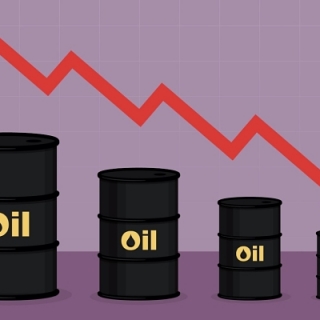
Oil prices plummeted on Wednesday (October 15th), holding near five-month lows for a second day, pressured by escalating US-China trade tensions and the International Energy Agency's (IEA) prediction of a supply surplus by 2026.
Brent crude fell 23 cents, or 0.4%, to $62.16 a barrel at 11:11 a.m. EDT (15:11 GMT). U.S. West Texas Intermediate crude fell 14 cents, or 0.2%, to $58.56. Both benchmarks were heading for their lowest close since May 7 for the second straight day.
Bank of America said Brent could fall below $50 a barrel if US-China trade tensions escalate while OPEC+ production increases. On Tuesday, the IEA stated that the global oil market could face a surplus of up to 4 million barrels per day next year, larger than previously estimated, as OPEC+ and other countries increase production while demand remains sluggish.
The trade dispute between the world's two largest oil consumers has escalated over the past week, with the US and China imposing additional port fees on ships transporting cargo between them. This tit-for-tat action could disrupt global shipping flows.
US Treasury Secretary Scott Bessent reiterated on Wednesday that Washington does not want to escalate the trade conflict, stressing that President Donald Trump is ready to meet with Chinese President Xi Jinping in South Korea later this month.
Last week, China announced it would increase controls on rare earth exports, and Trump threatened to raise tariffs on Chinese goods to 100% and tighten restrictions on software exports starting November 1. Deflationary pressures persist in China, with consumer and producer prices falling in September, along with a prolonged property market slump and trade tensions.
In the US, investors are increasingly confident that the Federal Reserve will continue to cut interest rates. On Tuesday, Fed Chairman Jerome Powell opened the door to further interest rate cuts and said the end of the central bank's long effort to reduce its holdings may be near. Looser economic policies could boost economic growth and oil demand.
The UK on Wednesday targeted Russia's two largest oil companies, Lukoil and Rosneft, as well as 51 shadow tankers in what it described as a new effort to tighten energy sanctions and limit the Kremlin's revenues. Russia was the world's second-largest crude oil producer after the US in 2024, according to US energy data. Any escalation of sanctions due to Moscow's war with Ukraine would prevent more of that oil from reaching the global market.
In Azerbaijan, oil production fell 4.2% to 20.7 million metric tons in January-September from 21.6 million metric tons a year earlier, the Energy Ministry said on Wednesday. Azerbaijan is a member of the Organization of the Petroleum Exporting Countries (OPEC+) group of countries and its allies.
US OIL INVENTORIES
The American Petroleum Institute (API) and the US Energy Information Administration (EIA) are scheduled to release weekly US inventory data on Wednesday and Thursday, a day later than usual due to the Columbus Day/American Indigenous Peoples Day holiday on Monday.
Analysts estimate US crude oil inventories rose by about 0.2 million barrels last week. If confirmed, it would be the first time energy companies have added oil to storage for three consecutive weeks since April. This compares with a decline of 2.2 million barrels during the same week last year and an average increase of 1.1 million barrels over the past five years (2020-2024). (alg)
Source: Reuters
Oil prices stabilized on Thursday (February 12th), as the market reassigned a risk premium to US-Iran tensions despite US inventory data showing swelling domestic supplies. This movement confirms one ...
Oil prices rose on Wednesday (February 11th), supported by a combination of geopolitical risk premiums from US-Iran tensions and more solid Asian demand signals particularly from India which helped ea...
Oil remained in the green zone on Tuesday (February 10th), as the market refused to abandon the Middle East risk premium. As of 13:07 GMT (20:07 WIB), Brent rose +0.4% to $69.32/barrel, while WTI rose...
Oil prices fell about 1% on Monday as concerns about conflict in the Middle East eased slightly. The market calmed after the US and Iran agreed to resume talks on Tehran's nuclear program, reducing fe...
Oil prices moved slightly higher in a volatile session on Friday, as investors assessed the direction of nuclear negotiations between the United States and Iran. Price movements appeared sensitive to ...
Oil prices stabilized on Thursday (February 12th), as the market reassigned a risk premium to US-Iran tensions despite US inventory data showing swelling domestic supplies. This movement confirms one thing: geopolitical headlines are still more...
Gold prices weakened slightly on Thursday (February 12th), as more solid US employment data reduced market confidence in an imminent Federal Reserve interest rate cut. The strong employment data prompted market participants to shift expectations of...
The Hang Seng Index reversed its downward trend in Hong Kong on Thursday (February 12th), weakening by around 0.9% to around 27,000 after a strong session earlier. This decline halted the momentum of the short term rally, as investors began to...