


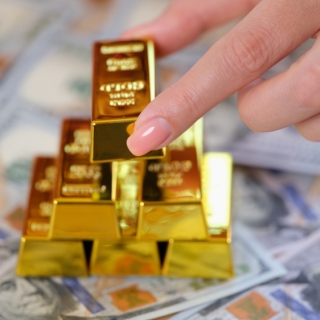
Goldman Sachs on Monday raised its year-end 2025 gold price forecast to $3,100 per ounce, up from $2,890, citing sustained central bank demand.
The bank estimates that "structurally higher central bank demand will add 9% to the gold price by year-end, which combined with a gradual boost to ETF holdings as the funds rate declines."
This should outweigh the drag from normalizing investor positioning, assuming uncertainty diminishes, Goldman Sachs added.
However, if policy uncertainty, including tariff concerns, remains high, Goldman sees the potential for gold to surge to $3,300 per ounce by year-end due to prolonged speculative positioning.
The bank has also revised its central bank demand assumption upward to 50 tonnes per month from the previous estimate of 41 tonnes.
If purchases average 70 tonnes per month, gold prices could climb to $3,200 per ounce by the end of 2025, assuming positioning normalizes, Goldman said.
Conversely, if the Federal Reserve keeps interest rates steady, the bank expects gold to reach $3,060 per ounce in the same period, the bank added.
Reiterating its "Go for Gold" trading recommendation, Goldman Sachs said that while declining uncertainty could lead to a tactical pullback in prices, long gold positions remain a strong hedge.
This is particularly relevant in the face of potential trade tensions, Federal Reserve subordination risks, and financial or recessionary threats, which could push prices toward the upper end of Goldman's high-uncertainty range, the bank said.
Additionally, if concerns over U.S. fiscal sustainability escalate, Goldman Sachs sees gold rising an extra 5% to $3,250 per ounce by December 2025.
Growing fears of inflation and fiscal risks could drive speculative positioning and ETF flows higher, while worries about U.S. debt sustainability may encourage central banks, especially those with large U.S. Treasury reserves, to increase their gold purchases, the investment bank added.
Gold prices weakened slightly on Thursday (February 12th), as more solid US employment data reduced market confidence in an imminent Federal Reserve interest rate cut. The strong employment data promp...
Gold prices strengthened on Wednesday, supported by a weaker US dollar and falling US bond yields after the latest economic data reinforced the narrative that the Federal Reserve is likely to continue...
Gold experienced a slight correction in the European session on Tuesday (February 10th), but remained above $5,000/oz as the market held its breath ahead of a series of US data that could alter intere...
Gold held above the psychological $5,000 level at the start of the week, supported by a combination of factors that are "right" for the precious metal : physical demand from China, expectations of low...
Gold prices are still struggling to turn an intraday rebound into a sustained rally. After briefly falling to $4,654 (a four day low) and rebounding, prices were again rejected near $4,900. In the Eur...
Oil prices stabilized on Thursday (February 12th), as the market reassigned a risk premium to US-Iran tensions despite US inventory data showing swelling domestic supplies. This movement confirms one thing: geopolitical headlines are still more...
Gold prices weakened slightly on Thursday (February 12th), as more solid US employment data reduced market confidence in an imminent Federal Reserve interest rate cut. The strong employment data prompted market participants to shift expectations of...
The Hang Seng Index reversed its downward trend in Hong Kong on Thursday (February 12th), weakening by around 0.9% to around 27,000 after a strong session earlier. This decline halted the momentum of the short term rally, as investors began to...