


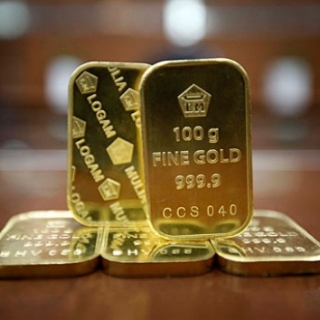
Gold (XAU/USD) prices seesawed between modest gains/minor losses through the first half of the European session on Tuesday (February 4) as it remained close to its all-time tops touched the previous day. US President Donald Trump's decision to temporarily suspend tariffs on Mexico and Canada, after reaching a border security deal with the two countries, boosted investor confidence. The risk-on flow, along with the Federal Reserve's (Fed) hawkish pause, provided a modest lift to the US Treasury bond yields and helped the US Dollar (USD) regain some positive traction after the previous day's U-turn. This, in turn, was seen acting as a headwind for the commodity.
The intraday downtick, however, stalled ahead of the $2,800 mark amid concerns about the potential economic impact of US President Donald Trump's trade tariffs, which continued to lend support to the safe-haven Gold prices. Further, expectations that Trump's protectionist policies will lead to higher US inflation turned out to be another factor that benefitted the XAU/USD's status as a hedge against rising prices and helped limit the downside. This, in turn, suggests that the path of least resistance for the bullion remains upwards and any correction in the future might still be seen as a buying opportunity, warranting caution for aggressive bearish traders.
From a technical perspective, the Relative Strength Index (RSI) is already flashing slightly overbought conditions on the daily chart. This makes it prudent to wait for some near-term consolidation or a modest correction before the next leg up. That said, any corrective slide below the immediate support of $2,800 might still be seen as a buying opportunity and remain limited near the $2,773-2,772 horizontal resistance breakout point. However, some follow-through selling could pave the way for a further decline towards the $2,755 zone en-route the $2,725-2,720 region and the $2,700 cap.
On the flip side, investors are likely to take a breather near the $2,830 area, or the record high touched on Monday. However, some follow-through buying would be the beginning of a continuation of the well-established trend seen from the December swing low, around the $2,583 area.(Newsmaker)
Source: FXstrett
Gold prices weakened slightly on Thursday (February 12th), as more solid US employment data reduced market confidence in an imminent Federal Reserve interest rate cut. The strong employment data promp...
Gold prices strengthened on Wednesday, supported by a weaker US dollar and falling US bond yields after the latest economic data reinforced the narrative that the Federal Reserve is likely to continue...
Gold experienced a slight correction in the European session on Tuesday (February 10th), but remained above $5,000/oz as the market held its breath ahead of a series of US data that could alter intere...
Gold held above the psychological $5,000 level at the start of the week, supported by a combination of factors that are "right" for the precious metal : physical demand from China, expectations of low...
Gold prices are still struggling to turn an intraday rebound into a sustained rally. After briefly falling to $4,654 (a four day low) and rebounding, prices were again rejected near $4,900. In the Eur...
Oil prices stabilized on Thursday (February 12th), as the market reassigned a risk premium to US-Iran tensions despite US inventory data showing swelling domestic supplies. This movement confirms one thing: geopolitical headlines are still more...
Gold prices weakened slightly on Thursday (February 12th), as more solid US employment data reduced market confidence in an imminent Federal Reserve interest rate cut. The strong employment data prompted market participants to shift expectations of...
The Hang Seng Index reversed its downward trend in Hong Kong on Thursday (February 12th), weakening by around 0.9% to around 27,000 after a strong session earlier. This decline halted the momentum of the short term rally, as investors began to...